This Headline Looks Old-Fashioned. Can you tell why?
The AP style guide can help you stand out amidst a torrent of AI-generated content.

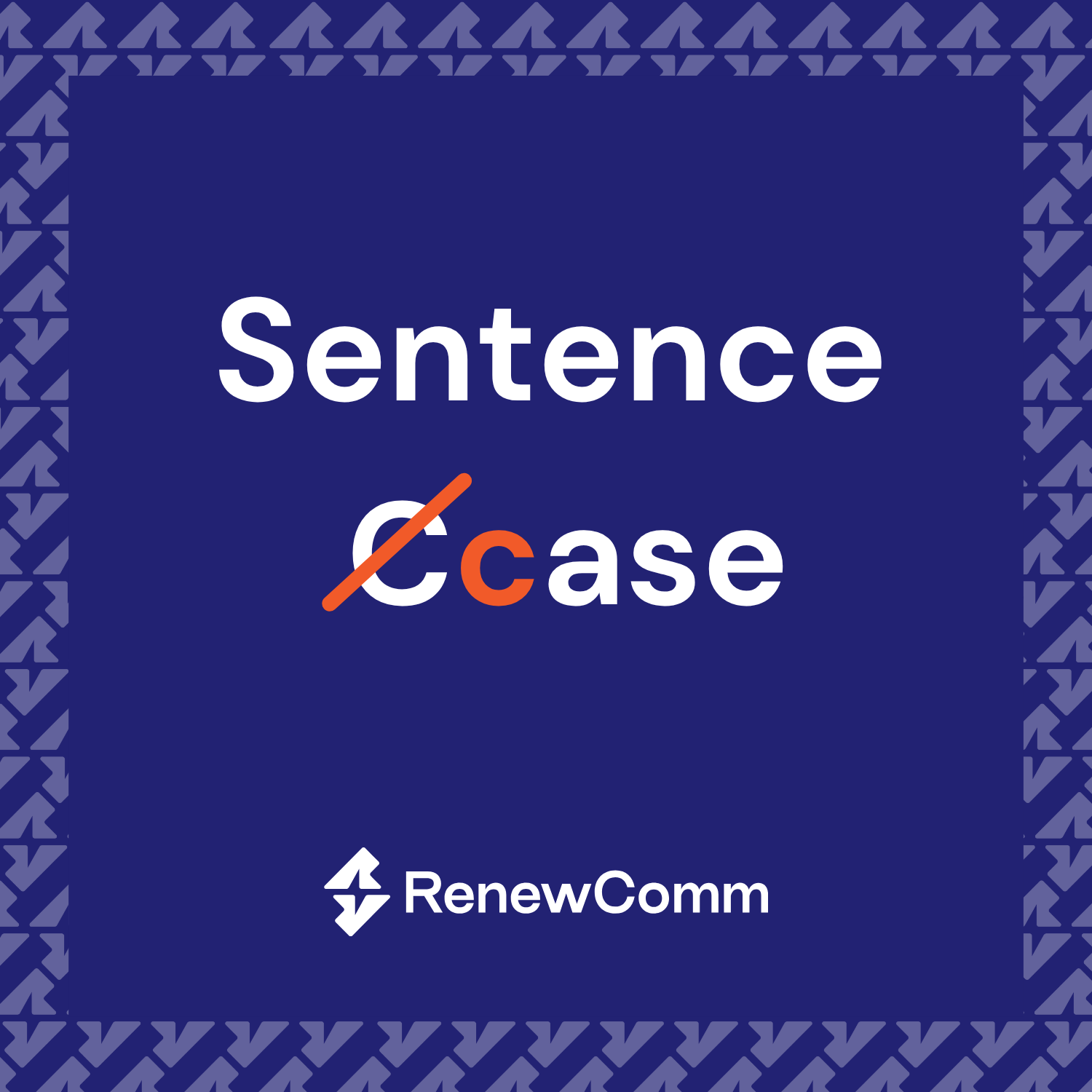
It's become fashionable — and unavoidable — to talk about AI "tells." One of the most obvious appears in the first words above: Title Case.
To newcomers, it might seem that we at RenewComm belong to a cult. Call it the cult of the Associated Press Stylebook.
On a near-daily basis we talk about how somebody, somewhere, has written something in Title Case, in which all the major words are capitalized.
Whereas I've developed a reputation for being a stickler on “sentence case,” as AP style requires. What's that, you say? It means you only capitalize the first letter of a headline, as you do in a sentence, plus any proper nouns such as United States or Google.
Our Slack is littered with times I’ve said, “We never use Title Case for any reason. When in doubt, it’s always sentence case.”
Why sentence case?
From 90% to 95% of American newspapers and digital outlets now use sentence case in their headlines, as I just did in the subhead above. That includes wire services like AP and Reuters, digital newsrooms like CNN, NPR and Vox, and major metro dailies. The Washington Post made the switch in 2009. (Notable outliers: The New York Times and The Wall Street Journal.)
The case for sentence case:
It's easier to read quickly. It makes proper nouns like product names stand out, instead of hiding them in a sea of capital letters.
It saves precious space in headlines and email subjects, where capital letters would take up slightly more of it.
We pitch a lot of reporters and editors on story ideas and columns. They’re used to seeing it this way.
We have to choose one or the other to be consistent, and we’ve chosen sentence case (since we’re an AP style shop). Plus it looks fresh and modern.
Capitalizing Every Word Looks So Old-Fashioned. We’re not typing on typewriters anymore, people!
Where Title Case still rules
To be fair, Title Case has its defenders, and there’s a history here. The Times and The Journal treat all those capital letters as part of their brand identity.
More magazines than newspapers still use it, including The New Yorker, The Atlantic and Wired, and most academic journals. For them, it’s part of their visual signature, like a logo or typeface.
These stylistic decisions are being made centuries after the invention of the words “uppercase” and “lowercase” themselves. They describe how lead type was physically stored: Capital letters sat in a slanted case above the human typesetter, requiring an extra reach for Title Case which was then standard. The more frequently used lowercase letters sat right at their fingertips, in the case below.
Many people still capitalize all kinds of things anyway. A friend who works for the federal government (note: not the Federal Government), puts it this way: "Everyone does it. I'm constantly uncapitalizing things."
Why AI still uses Title Case
Here's the twist: The newest defenders of Title Case aren't O.G. editors. They're chatbots.
Ask Gemini, ChatGPT or Claude a question, and you’ll get back a lot of subheadings in Title Case by default. Large language models train on enormous amounts of text, including academic writing and web content (not just news). There Title Case is more common, following style guides like Chicago or MLA.
The AP's sentence-case rule was built for newspapers, to save space and mimic how people actually talk. AI models aren’t trained to be newspapers; they’re trained to be general-purpose writing partners, and they still default to the publishing norm.
In a chat window full of Markdown, a Title Case heading (## Like This One) contrasts with sentence-case body text, which some say makes it easier to scan.
The good news (for me, at least) is that Title Case isn't hard-coded. Plenty of serious style guides — including Google's own standard for software documentation — require sentence case for the reasons newspapers do: clarity and speed.
If you tell your AI model to follow AP style, or simply to "use sentence case for headings," it will.
Why you want a marketing agency that cares about this
Painfully, I'll remove my sentence-case-promoter hat here and admit there are smart people on both sides of this divide. My point isn't to declare the other side wrong. It's to illuminate one of the many small decisions that go into writing well.
Great writing arises from hundreds of choices — using colorful verbs instead of leaning on "is" and "are," for example; trimming a sentence until only necessary words remain; even deciding when a rule deserves an exception. (We do capitalize titles, even after a name. People love their titles!)
Our job includes making those calls for you, so that your company's writing represents your brand properly and stands out from the pack, instead of reading like it came from the nearest chatbot.
Clean, confident sentences that follow the rules carry more impact. That's why we care about something as small as a capital letter — and why, when in doubt, we always use sentence case.
Can we tackle a research and writing job for you, maybe a white paper or case study on your company’s signature achievement? We start with an actual conversation with your subject matter experts, recorded and transcribed, so your words and ideas take center stage. And that’s a topic for another column.
Related Posts

Show, don’t tell: the key to services marketing
Services companies face a unique challenge: Most of their competitors can make the same pitch.

RenewComm launches a new brand built for the energy transition era
CHICAGO, IL (August 5, 2026) — RenewComm, the specialist cleantech marketing and PR agency, today unveiled a fresh, bold look for their brand. The rebrand was led by the team at bennu, an employee-owned growth strategy agency dedicated to working for companies doing the work the world actually needs.